Lean UAV systems for an asymmetric era
Complete unmanned aircraft systems for government and institutional operators — designed in Türkiye.
We're designing and building toward complete airframes, avionics, and ground systems for each platform. Our combat systems are built to be expendable: low cost, fast to produce, modular by design. ISR variants, subsystem supply, and consulting work follow the same lean discipline, but are not constrained by expendability requirements.
Why we're called Hendek
Hendek means "trench" in Turkish, and the name points to the Battle of the Trench — where an outnumbered defender held a stronger force at bay by digging a trench instead of meeting it head-on. Asymmetric, low-cost, and effective. That is the engineering approach behind this company.
We are a lean, Türkiye-based UAV manufacturer building complete systems for government and institutional operators. Because our combat systems are expendable, we design for low cost, fast production, and modularity — and we spend engineering effort only where a specific requirement justifies it. Over-engineering is treated as a defect, not a virtue.
That same discipline carries into rapid prototyping: we iterate designs with 3D printing before committing to tooling or composite layup, so a design earns its production method rather than defaulting to one.
Hendek is pre-prototype and seed-stage today. Every system on this site is shown with its current development status — we'd rather be precise about where we are than oversell where we're going.
Hendek Havacılık — Turkish operating name
Complete UAV Platforms
Two tiers, built around a shared design philosophy: every airframe earns its construction method, and every system states its real development stage.
Tactical Tier — Delta-Wing OWA & ISR
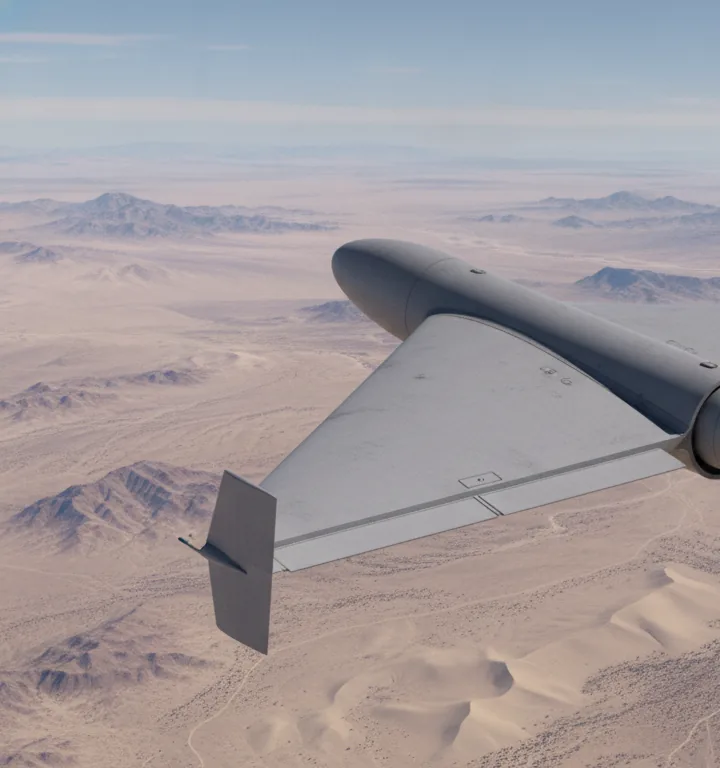
OWA (one-way attack) and ISR (intelligence, surveillance, reconnaissance) payloads share the same airframe here: a delta-wing pusher configuration with a twin-piston engine driving a single pusher propeller. Non-modular carbon/glass-fibre structure, optimized for low-cost, high-rate production.
Our own launcher is the primary system offering. A vehicle-mounted (car-launched) thrower design is already complete and ready for the next stage; rocket-assisted, catapult, and rail options remain in development. The platform is also designed to be launcher-agnostic as a secondary capability.
Subsystem Readiness
Figures shown are current design targets for a pre-prototype platform, not validated flight performance. Detailed specifications are available under NDA for qualified government and institutional inquiries.
Small Tier — Electric, Dual-Role
Two variants share a common backbone and differ only in airframe construction. Both accept either a strike payload (OWA) or an ISR sensor package in the same payload bay, so one platform serves two missions.
Shared Backbone — Both Variants
Modular Variant
Fast and inexpensive to manufacture, built for high-volume expendable use. A common fuselage accepts three interchangeable module sets — range, endurance, or speed — so one production line covers three mission profiles.
Efficiency Variant
Carbon and glass fibre construction for missions where range or endurance justifies a higher unit cost. Same backbone and dual-role payload bay as the modular variant, built to a higher performance ceiling.
Guidance & Payload Options — Across the Portfolio
Beyond Complete Systems
Two service lines that put our existing manufacturing and engineering capacity to work between government programmes.
Airframe & Structures Supply
We design and manufacture UAV airframes and structural components for third-party UAV companies that need reliable production capacity without building it in-house. At least one prospective client is already identified.
- Carbon & glass fibre airframes
- Wing and tail assemblies
- Custom structural components
- 3D-printed structural parts
- Small-batch & serial production
Systems & Aeronautical Consulting
Clearly scoped systems-level and aeronautical engineering consulting with defined deliverables — not open-ended advisory work — so engagements stay focused and your IP stays protected.
- Full aircraft / UAV design
- UAV system architecture & requirements
- Airframe structural analysis
- Propulsion system selection & sizing
- Composite manufacturing process design
- Rapid prototyping strategy
How We Build
Production methods are chosen per design, not assumed in advance.
CF / GF Composite
Carbon and glass fibre layup for platforms where performance, range, or structural loading justify the added cost — the Efficiency variant and the Tactical Tier.
Low-Cost Modular Construction
Fast, inexpensive airframe construction for the high-volume Modular variant, built to be produced and replaced at expendable-system cost.
3D-Printed Prototyping
A cross-cutting R&D capability, not a standalone product line — used to iterate every design quickly before it earns its production method.
Founder

Mechanical Engineer with 8+ years across UAV systems, aerospace propulsion, and high-temperature materials. Oxford MSc by Research in Nickel-Based Single-Crystal Superalloys, with Siemens Energy as research sponsor; Cranfield MSc in Aerospace Propulsion, in collaboration with Rolls-Royce.
Led the R&D and propulsion unit at a Turkish defence-industry programme, including a TÜBİTAK-supported development effort, and introduced 3D-printed prototyping to validate designs before committing to moulds — avoiding the cost and risk of remaking tooling after a mistake. Has personally designed, built, and flown fixed-wing UAVs, and holds an SHGM UAV pilot certificate.
Start a Conversation
For government and institutional inquiries, subsystem supply, investor and funding conversations, or scoped consulting work, reach out directly.
Submitted securely — we reply by email, usually within two business days.